4 myths about a secured card deposit
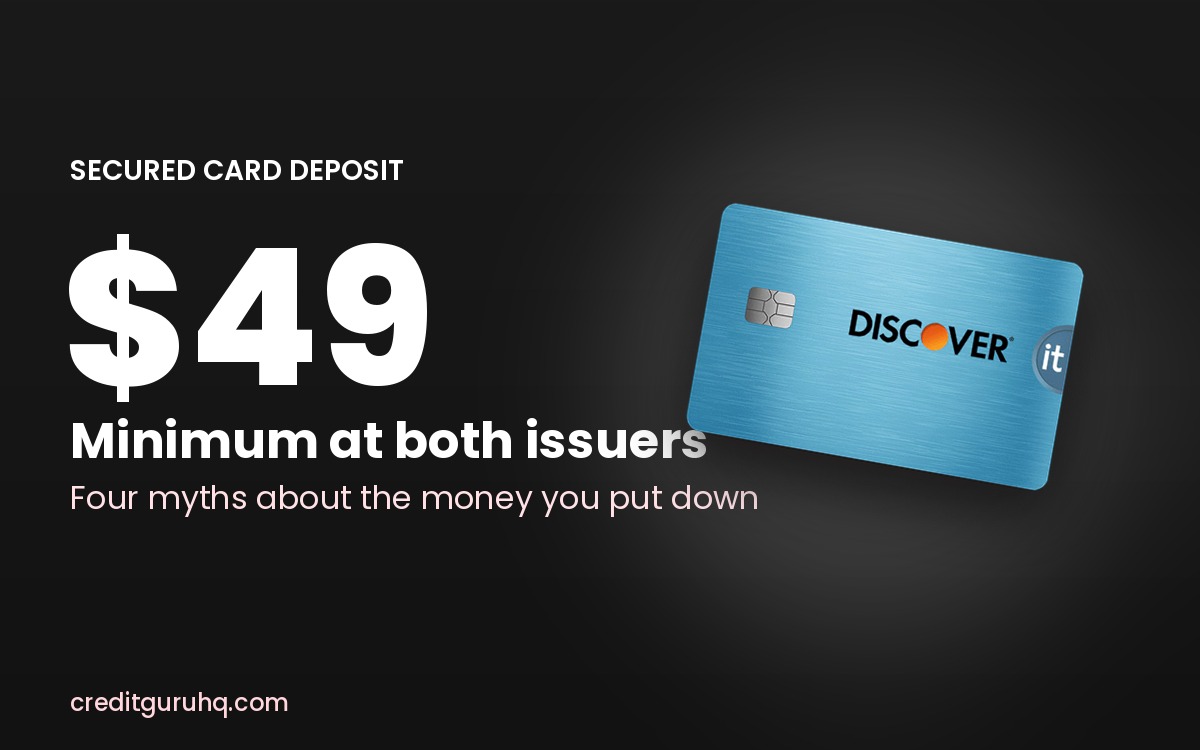
When you open a secured credit card, you put down a refundable cash deposit that usually sets your credit limit. A common set of myths follows that money: that it pays your bill, that it's gone for good, that it earns interest, or that the card doesn't build credit. Here's what Capital One and Discover actually say about their secured cards, checked on November 19, 2026 (ET). This is about the deposit itself, not how a secured card compares with other credit-building products.
Myth 1: The deposit pays your monthly bill
It doesn't. Capital One's Platinum Secured FAQ asks whether the security deposit covers monthly payments for charges on the card, and answers no: you must still make at least your minimum monthly payment each month. Discover's it Secured FAQ uses the same rule in the same words.
The deposit is collateral, not a prepaid balance you spend down to pay the bill. If you miss payments, you can still go delinquent even though the issuer is holding your cash.
Myth 2: The deposit is gone for good
Both issuers name two ways the deposit can come back.
First, you can earn it back with a positive track record. The path is not identical. Capital One says you can earn the deposit back if you are upgraded to an unsecured card after using the secured card responsibly, and it also mentions earning the deposit back as a statement credit. Discover says that with a positive track record, you can earn the deposit back as a statement credit. Neither page promises a timeline, or that you will be upgraded.
Second, both say they will refund the deposit when you close the account and pay your balance in full.
The Consumer Financial Protection Bureau (CFPB) puts it more generally: as you show you can pay on time, your credit limit may be raised and you may have your deposit refunded. That "may" matters. Don't count on a date.
Myth 3: The deposit earns interest while the issuer holds it
Both issuers say no interest is applied to the deposit. Capital One writes, "No interest is applied to the security deposit." Discover writes, "No interest is applied to the deposit." Your money is sitting there as security, not in an interest-bearing savings account.
Myth 4: Secured cards don't build credit
Capital One and Discover both say your card status will be regularly reported to the three major credit bureaus. That's how a secured card can help establish a credit record, if you pay on time.
The CFPB still cautions you to ask your issuer whether it reports, because not every card works the same way. The CFPB also notes that fees and interest rates can be high for secured cards, but using one can help you establish a credit record.
The numbers these two issuers publish
These figures come from Capital One Platinum Secured and Discover it Secured. They are not a rule for every secured card:
- $49 is the minimum refundable deposit at both. Capital One lists a $49, $99, or $200 minimum. Discover says refundable deposits as low as $49 unlock credit lines starting at $200, and a footnote says the deposit will be $49, $99, or $200 based on creditworthiness.
- Capital One gives you 35 days after approval to make the minimum deposit.
- Discover's starting credit line, at that $49 minimum, is $200.
How to use these facts
- Keep paying the bill. The deposit does not cover your minimum payment.
- Ask how earn-back works on your specific card: an upgrade, a statement credit, or both, and whether any timeline is published. These two issuers do not promise one.
- Ask whether the issuer reports to all three major credit bureaus before you apply or fund the deposit.
- Budget for a deposit that may not earn interest while it's held, and for the possibility that you only get it back when the account is closed and paid in full.
- Read the issuer's own secured-card page for the current deposit amounts and refund rules, because terms can change.
These points come from Capital One's Platinum Secured page, Discover's it Secured page, and the CFPB pages linked above. Other issuers can use different deposit amounts, refund rules, and reporting practices.
Card image courtesy of Discover. Discover it Secured is a trademark of its owner.
Not financial advice.